
Introduction
Drilling fluids play a critical role in oil and gas operations, acting as the backbone of efficient and safe drilling. These fluids are formulated using a combination of chemical additives to control key properties such as viscosity, density, lubrication, and fluid loss. A properly engineered drilling fluid system ensures smooth drilling operations, effective cuttings removal, and wellbore stability.
Explore our complete range of drilling fluid chemicals designed for high-performance oilfield applications.
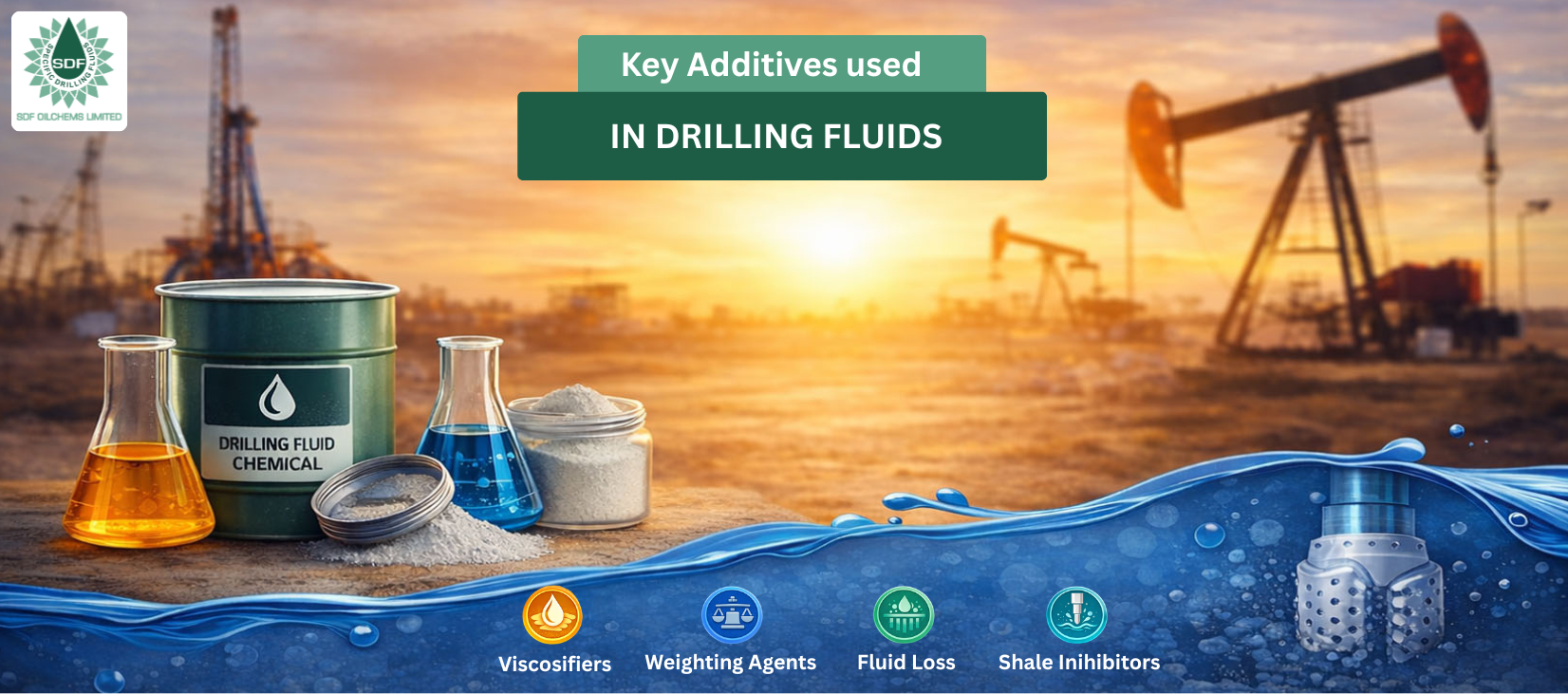
Common Additives in Drilling Fluids
1.Viscosifiers
Viscosifiers such as bentonite and polymer-based additives are used to increase the viscosity of drilling fluids, enabling efficient lifting and suspension of drill cuttings. They help maintain proper hole cleaning and prevent solids from settling when circulation stops. Viscosifiers also improve fluid stability under varying temperature and pressure conditions. Explore our bentonite-based viscosifiers for reliable drilling performance.
2. Weighting Agents
Weighting agents like barite and hematite are essential for increasing the density of drilling fluids to control formation pressure and avoid blowouts. These additives help maintain hydrostatic balance and ensure safe drilling operations. Proper mud weight also stabilizes the wellbore and prevents influx of formation fluids. Check out our high-purity barite products for effective density control.
3. Fluid Loss Additives
Fluid loss additives such as PAC (Polyanionic Cellulose) and starch are used to minimize the loss of drilling fluid into porous formations. They form a thin filter cake on the wellbore wall, reducing fluid invasion and protecting the reservoir. These additives also enhance wellbore integrity and improve drilling efficiency. Explore our PAC and filtration control additives for better fluid loss management.
4. Shale Inhibitors
Shale inhibitors like potassium chloride (KCl), glycols, and polyamine-based chemicals help prevent swelling and dispersion of reactive shale formations. They work by limiting water interaction with clay minerals, thereby improving wellbore stability. Effective shale inhibition reduces drilling complications such as tight holes and wellbore collapse. Discover our shale inhibition solutions for challenging formations.
5. Lubricants
Lubricants are used to reduce friction between the drill string and the wellbore, especially in directional and horizontal drilling. They help minimize torque and drag, ensuring smoother drilling operations and reducing equipment wear. Lubricants also prevent differential sticking and improve overall drilling efficiency. Check our high-performance drilling lubricants for optimized operations.
Conclusion
Selecting the right combination of drilling fluid additives is essential for achieving optimal drilling performance and operational safety. A well-balanced fluid system enhances cuttings transport, maintains pressure control, and ensures wellbore stability. It also helps reduce non-productive time (NPT) and overall operational costs. Investing in high-quality drilling fluid chemicals ultimately leads to safer, faster, and more cost-effective drilling operations.
FAQs on Drilling Fluid Additives
1. What are drilling fluid additives?
Drilling fluid additives are chemicals added to drilling mud to control properties like viscosity, density, and fluid loss for efficient drilling operations.
2. Why are viscosifiers used in drilling fluids?
Viscosifiers increase the thickness of drilling fluids, helping in better suspension and transport of drill cuttings.
3. What is the role of weighting agents in drilling fluids?
Weighting agents like barite are used to control formation pressure and maintain well stability during drilling.
4. How do shale inhibitors work?
Shale inhibitors prevent swelling and dispersion of clay formations, reducing wellbore instability and drilling issues.