Introduction
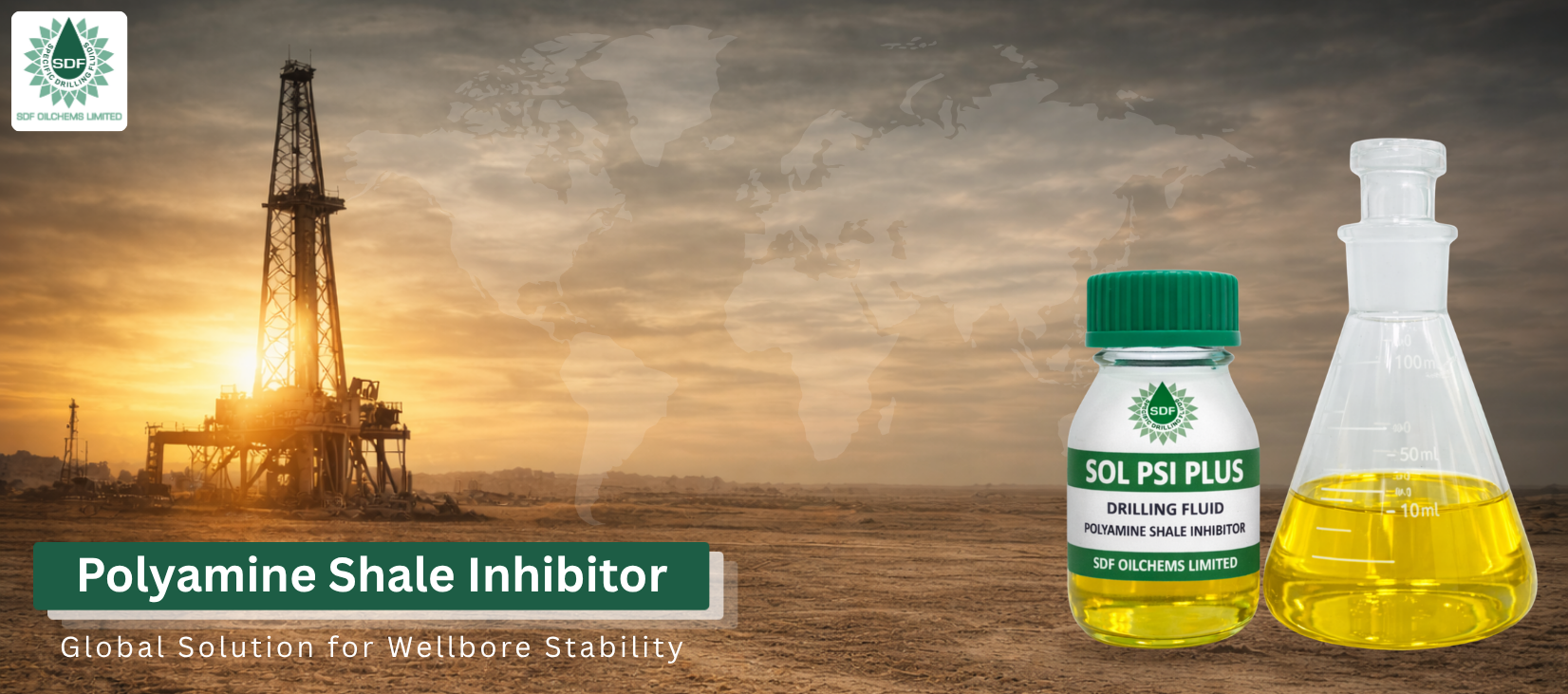
Shale instability is one of the most critical challenges in modern oil and gas drilling. Across regions such as Saudi Arabia, United States, and UAE, drilling operations frequently encounter issues like shale swelling, dispersion, and wellbore collapse.
To address these challenges effectively, polyamine shale inhibitors are widely used in water-based drilling fluid systems due to their superior inhibition performance and operational reliability.
What is Polyamine Shale Inhibitor
Polyamine shale inhibitor is a specialized chemical additive used in water-based drilling fluids to control clay hydration and stabilize reactive shale formations.
Its primary functions include:
- Preventing shale swelling
- Reducing clay dispersion
- Maintaining wellbore integrity
Compared to conventional inhibitors such as potassium chloride (KCl), polyamine-based systems offer improved efficiency at lower concentrations and better environmental compatibility.
Working Mechanism of Polyamine
The effectiveness of polyamine shale inhibitors is based on multiple mechanisms:
Electrostatic Interaction
Polyamine molecules carry positive charges that interact with negatively charged clay surfaces, forming a strong adsorption layer.
Water Inhibition
This adsorption restricts water entry into clay layers, significantly reducing hydration and swelling.
Encapsulation
Polyamine forms a protective coating around shale particles, minimizing dispersion and improving cuttings integrity.
These combined effects result in enhanced wellbore stability and smoother drilling operations.
Global Relevance of Shale Inhibition
Shale-related drilling issues vary across regions but remain a consistent operational challenge.
Saudi Arabia
High-temperature wells and highly reactive shale formations increase the risk of instability.
United States
Unconventional shale plays such as Permian Basin and Eagle Ford involve complex mineralogy and horizontal drilling challenges.
UAE
Deep formations with mixed lithology require advanced inhibition systems for stable drilling performance.
Polyamine shale inhibitors provide a consistent and effective solution across these diverse conditions.
Comparison with Other Shale Inhibitors
KCl provides ionic inhibition but requires higher concentrations. Polyamine delivers stronger inhibition at lower dosage levels with reduced environmental impact.
Glycol performance is often temperature-dependent, whereas polyamine remains effective across a broader temperature range.
PHPA primarily offers encapsulation, while polyamine provides both inhibition and encapsulation, resulting in improved overall performance.
Applications in Drilling Operations
Polyamine shale inhibitors are widely used in:
- Water-based drilling fluids
- Horizontal and directional drilling
- High-pressure high-temperature wells
- Offshore drilling environments
They are particularly effective in reactive shale formations and high salinity conditions.
Key Benefits
- Strong shale inhibition performance
- Improved wellbore stability
- Reduced fluid loss and dispersion
- Enhanced rate of penetration
- Lower operational risks and costs
Performance in Challenging Conditions
Polyamine systems perform efficiently in:
- High temperature drilling environments
- Water-sensitive shale zones
- Deep and complex formations
- High salinity mud systems
Their versatility makes them suitable for a wide range of drilling scenarios.
Industry Demand and Future Outlook
With increasing drilling depths and more complex formations, the demand for advanced and efficient shale inhibition systems is growing globally.
Polyamine shale inhibitors are increasingly preferred due to:
- High efficiency
- Operational flexibility
- Environmental advantages
They are becoming a standard solution in modern drilling fluid design.
Selection Criteria
The selection of a suitable polyamine shale inhibitor depends on:
- Formation characteristics
- Temperature conditions
- Salinity levels
- Type of drilling fluid system
Optimized selection ensures better performance and cost efficiency.
Conclusion
Shale instability remains a major concern in drilling operations worldwide. Traditional inhibition systems are often insufficient under modern drilling conditions.
Polyamine shale inhibitors provide a reliable, efficient, and globally applicable solution for improving wellbore stability and overall drilling performance.