
Introduction
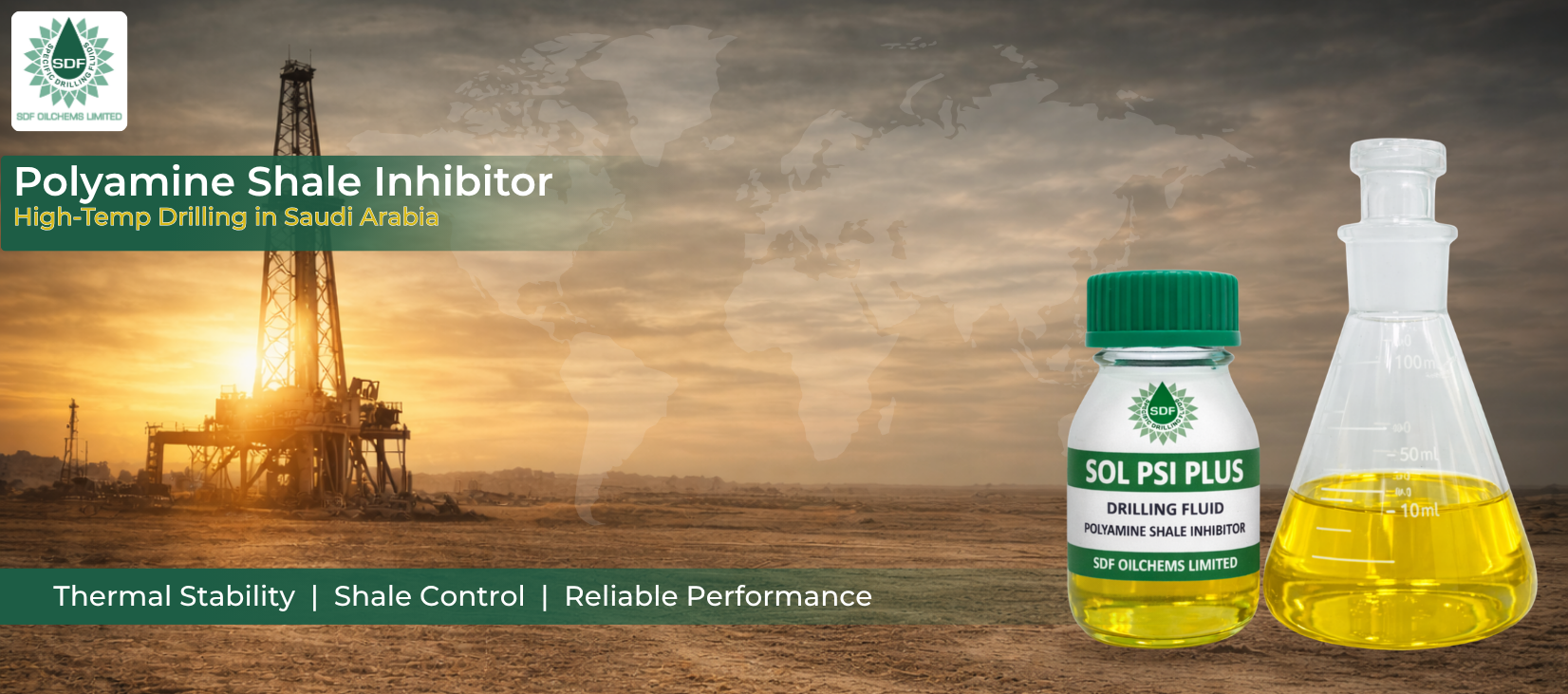
Drilling operations in Saudi Arabia present unique technical challenges due to high downhole temperatures, reactive shale formations, and complex geological conditions. These factors significantly increase the risk of shale swelling, dispersion, and wellbore instability.
To overcome these challenges, polyamine shale inhibitors are widely used in water-based drilling fluids to enhance stability and maintain drilling efficiency under extreme conditions.
Drilling Challenges in Saudi Arabia
Oilfields in Saudi Arabia are characterized by:
- High temperature reservoirs
- Reactive and water-sensitive shale formations
- Deep well drilling conditions
- High salinity environments
These conditions make conventional shale inhibition methods less effective, leading to issues such as:
- Shale swelling and hydration
- Wellbore collapse
- Increased torque and drag
- Poor hole cleaning
Shale Instability in High Temperature Wells
High temperature accelerates the interaction between drilling fluid and shale formations. This results in:
- Faster clay hydration
- Increased dispersion of cuttings
- Reduced structural integrity of the wellbore
In such environments, standard inhibitors like KCl often fail to provide adequate protection, especially at elevated temperatures.
Role of Polyamine Shale Inhibitor
Polyamine shale inhibitors are specifically effective in high temperature drilling environments due to their chemical stability and strong adsorption properties.
Key Functions
- Inhibits clay hydration by forming a protective layer
- Reduces shale swelling and dispersion
- Enhances cuttings integrity
- Maintains wellbore stability under extreme conditions
Mechanism of Action in Saudi Formations
Polyamine works through a combination of chemical and physical mechanisms:
Surface Interaction
Polyamine molecules attach to negatively charged clay surfaces, creating a stable barrier.
Water Blocking Effect
Prevents water molecules from entering clay layers, reducing swelling.
Thermal Stability
Maintains performance even at elevated temperatures, making it suitable for deep wells in Saudi Arabia.
Advantages Over Conventional Inhibitors
Compared to KCl
- Requires lower concentration
- More effective in high temperature conditions
- Reduced environmental impact
Compared to PHPA
- Provides both inhibition and encapsulation
- Better performance in reactive shale
Compared to Glycol
- Less dependent on temperature variations
- More consistent inhibition performance
Application in Saudi Drilling Operations
Polyamine shale inhibitors are commonly used in:
- Water-based mud systems
- Deep vertical and horizontal wells
- High-pressure high-temperature drilling
- Reactive shale zones
They are particularly beneficial in maintaining stability in long drilling intervals.
Operational Benefits
Use of polyamine shale inhibitors in Saudi Arabia results in:
- Improved wellbore stability
- Reduced non-productive time (NPT)
- Lower risk of stuck pipe incidents
- Better rate of penetration
- Optimized drilling fluid performance
Performance in High Salinity Conditions
Many Saudi formations involve high salinity environments, which can reduce the effectiveness of traditional inhibitors.
Polyamine systems:
- Remain stable in saline conditions
- Maintain inhibition efficiency
- Provide consistent performance across varying fluid compositions
Best Practices for Implementation
To achieve optimal performance:
- Select appropriate polyamine concentration based on formation
- Combine with compatible drilling fluid additives
- Monitor mud properties regularly
- Adjust formulation based on downhole conditions
Conclusion
Drilling in Saudi Arabia requires advanced solutions to handle high temperature and reactive shale formations. Conventional inhibition systems often fall short under such demanding conditions.
Polyamine shale inhibitors provide a reliable and efficient solution by offering strong inhibition, thermal stability, and adaptability to complex drilling environments.
Their use significantly improves wellbore stability and overall drilling performance in Saudi oilfields.